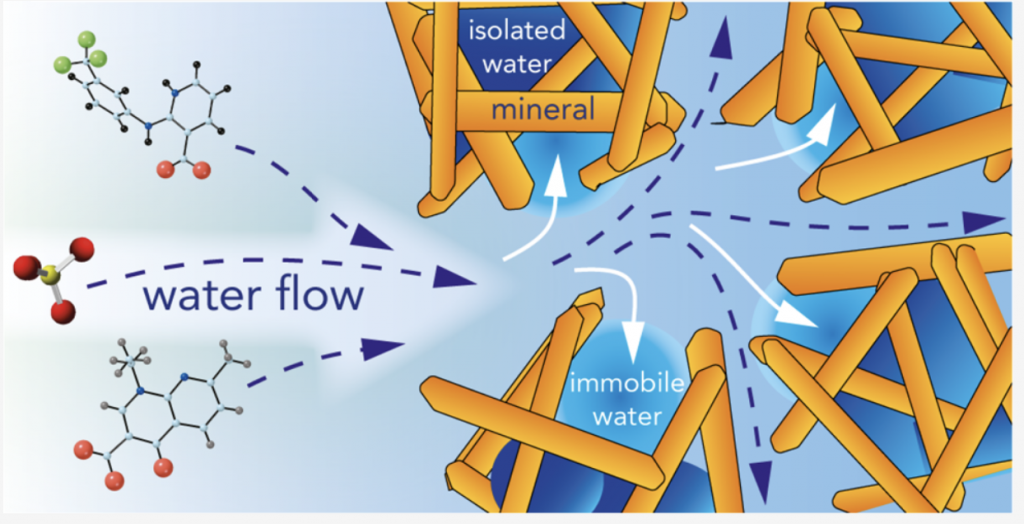
June 2022: CNRS (France) funds a 5-year project on coupled water flow and chemical reactivitywith Khalil Hanna, École nationale supérieure de chimie de Rennes (ENSCR))!
May-December 2022: PhD student Tao Luo (Rennes) joins us for an extended stay!
Our research program centers on understanding geochemical reactions at mineral surfaces, bridging molecular-scale processes to macroscopic environmental phenomena. We investigate how chemical reactions occur at the interfaces between minerals and fluids—from individual molecules interacting with single mineral particles to processes occurring across entire crystal surfaces.
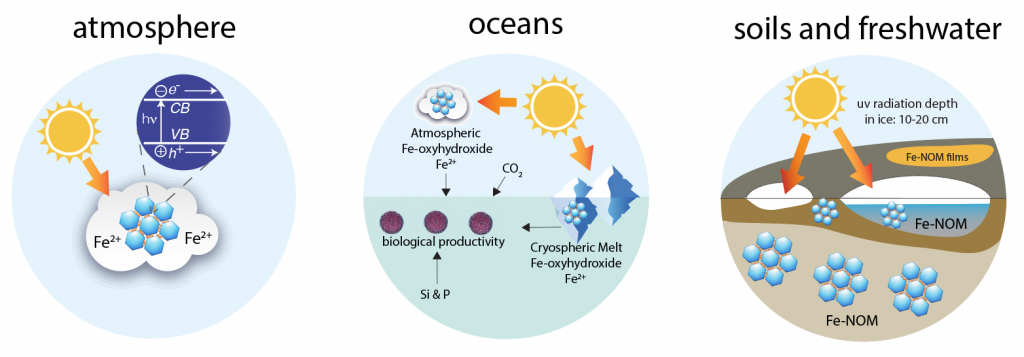
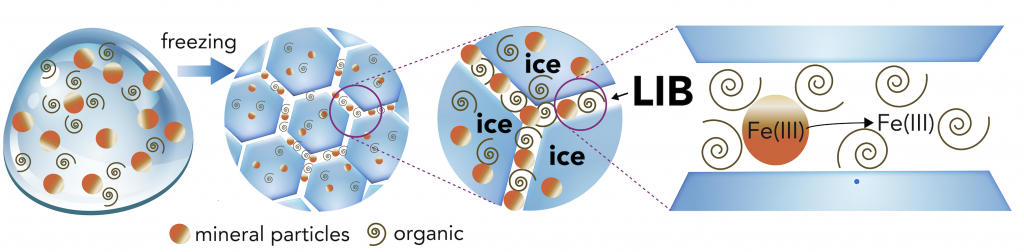
A central theme of our work involves thin water and ice films on mineral surfaces, exploring how these nanometric layers control ice nucleation, crystal growth, and interfacial electrochemistry. Our recent focus on ice geochemistry has revealed that ice is far from the inert substance traditionally assumed—instead, it acts as a dynamic geochemical reactor that dramatically alters mineral-water interactions. We’ve discovered how ice amplifies mineral dissolution in microscale hotspots, drives redox chemistry leading to the formation of reactive Mn(III) species, and accelerates ligand-promoted dissolution of iron oxyhydroxides. These ice-driven processes fundamentally change how we understand chemical weathering in cold environments, from Arctic soils to seasonal freeze-thaw cycles. Additionally, our work on CO2 mineralization in nanometric water films on mineral surfaces opens new pathways for carbon capture technologies, demonstrating how controlled ice formation could enhance natural weathering processes for climate solutions.
Our multidisciplinary approach seamlessly integrates advanced experimental techniques with theoretical modeling. We employ vibrational spectroscopy (FTIR, Raman, Sum Frequency Generation) and X-ray photoelectron spectroscopy to probe molecular-level interactions, while electrochemical methods like Electrochemical Impedance Spectroscopy (EIS) and Scanning Electrochemical Microscopy (SECM) reveal surface reactivity patterns. These experimental insights are interpreted through molecular simulations using Molecular Dynamics and Density Functional Theory, allowing us to visualize atomic-scale mechanisms.
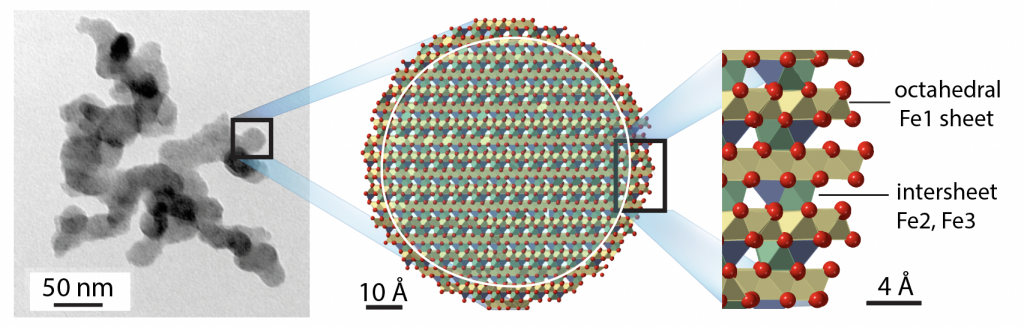
Our research extends beyond fundamental science to practical applications including CO2 capture technologies, pharmaceutical fate in aquatic systems, and Arctic environmental chemistry. From a materials science perspective, our work provides critical insights for developing functional geomaterials—natural and engineered mineral systems designed for environmental applications. We investigate how surface reactivity of iron oxides, manganese oxides, and clay minerals can be harnessed for contaminant removal, water treatment, and pollution control. Our studies on mineral nanoparticle aggregation, surface functionalization, and reactivity in complex environmental matrices inform the design of more effective geomaterial-based remediation systems. This includes exploring how waste rock materials can be transformed into reactive substrates for enhanced weathering and carbon capture, bridging fundamental surface chemistry with sustainable materials engineering. We develop thermodynamic and kinetic models that translate laboratory discoveries into predictive tools for atmospheric and geochemical processes, contributing to solutions for climate change and environmental remediation challenges.
Salient Funded Projects
Mineralogical Transformation in Ice (2025-2028)
Rust in Ice(2021-2024)
Chemistry Within the Confines of Mineral-Bound Thin Water Films (2017-2020)
Mineral Surface Structural Controls on Gas-Phase Adsorption Reactions (2013-2016)
Molecular Controls on CO2 Adsorption on Mineral Surfaces (2010-2012)
Direct Mineralization of Atmospheric CO2 by Enhanced Weathering(2023-2024)
Freeze/thaw controls on coupled water flow and chemical reactivity in icy environments(2023-2027) (w/ K. Hanna, Renne Institut of Chemical Sciences).